
How smart visual identity is quietly separating top-producing agents from the forgettable ones
There’s a moment every real estate agent knows. You hand someone your card — or they find you on Google — and in the space of about three seconds, they’ve already made a quiet judgment about you.
Not about your sales record. Not about your local market knowledge. About your logo.
It sounds shallow. But it isn’t. It’s actually deeply human. We’re wired to use visual signals as proxies for trust, especially when we’re about to make one of the biggest financial decisions of our lives.
A logo that looks generic or hastily assembled doesn’t just look cheap. It tells a buyer or seller, without a single word, that you might not sweat the details.
That’s the uncomfortable truth behind why real estate logo ideas matter more in 2026 than they ever have — and why the agents who understand this are quietly pulling away from those who don’t.
Key Takeaways
- Generic house-icon logos no longer signal professionalism — they signal sameness in a crowded market.
- The real estate logos that will dominate local markets in 2026 prioritize geographic identity, typographic confidence, and scalability across digital and print.
- Strong real estate branding isn’t about looking expensive — it’s about looking trustworthy and memorable in the specific market you serve.
- Logos built for yard signs and social media simultaneously give agents a compound visual advantage most competitors overlook.
Why Most Real Estate Logos Are Already Forgettable (And What’s Replacing Them)
Picture the five real estate logos you’ve seen most often in your area. There’s a reasonable chance that at least three of them share a common visual language: a stylized house outline, a generic serif font, and either navy blue, forest green, or burgundy red. Maybe a subtle roof-line lettermark.
None of them is bad, exactly. They just don’t say anything.
This is the core problem with most real estate branding today. Agents and brokerages default to category signaling — using visual shorthand that says “I am a real estate company” — instead of market positioning, which says “I am the real estate company for this kind of client in this kind of place.”
According to the Carps Corner, there are over 1.5 million active Realtors in the United States. In many metro areas, a buyer searching Google for a local agent will encounter dozens of results within a mile radius. In that environment, visual differentiation isn’t a branding luxury. It’s a competitive necessity.
The shift happening now — and accelerating into 2026 — is away from category signaling and toward what designers call positioned identity: a logo that communicates not just what you do, but who you’re for and where you belong.
What Actually Makes a Real Estate Logo Work in 2026
Before we talk about specific real estate logo ideas, it’s worth getting clear on the criteria. A logo that “looks good” and a logo that works are two different things. For real estate professionals operating in competitive local markets, a working logo has to do several things at once.
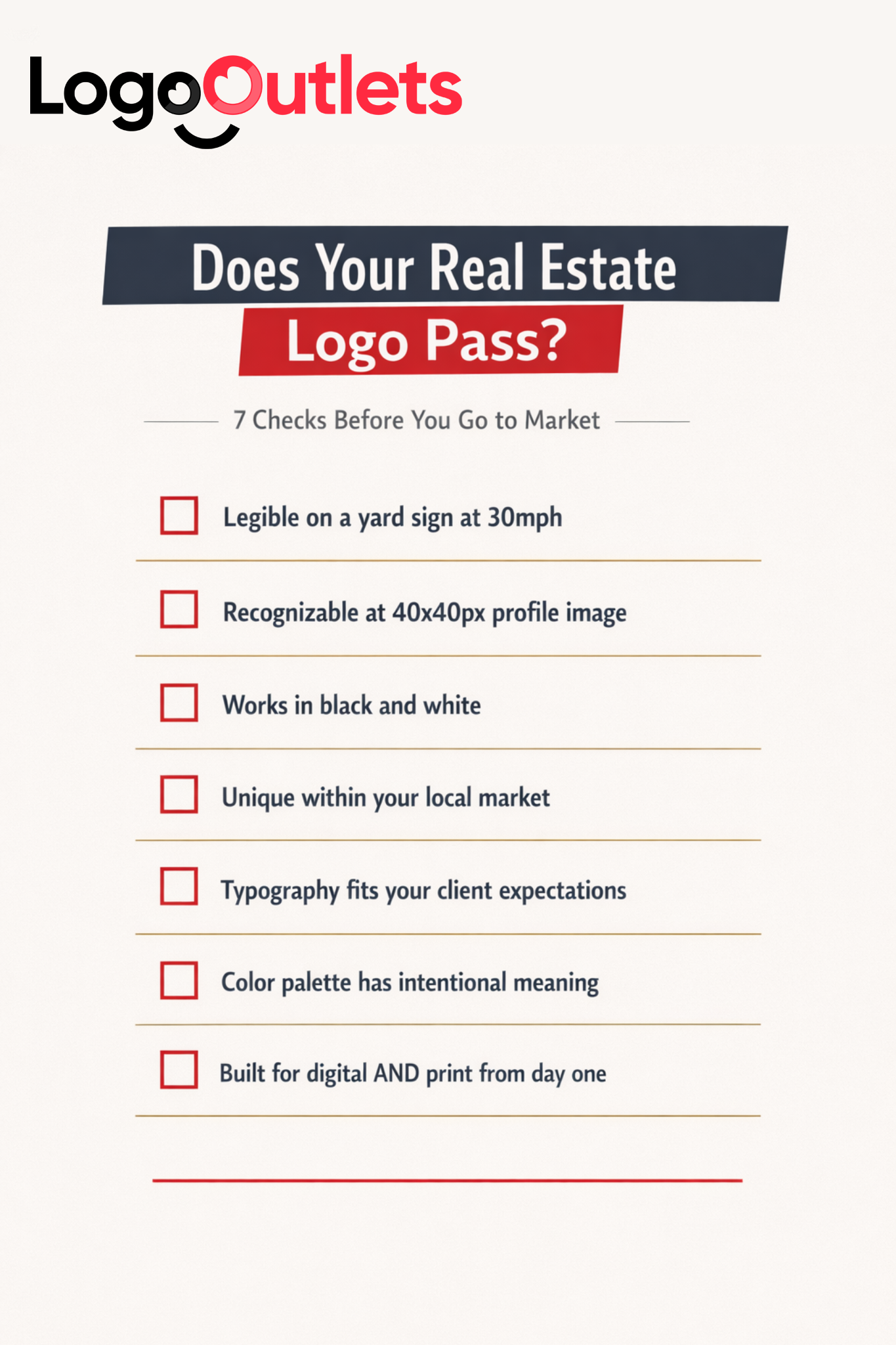
It needs to be legible at yard-sign scale from a moving car. It needs to look credible as a small avatar on a phone screen.
It needs to translate cleanly to black-and-white for print. And it needs to feel specific — tied to a market, an approach, a personality — not interchangeable with fifty other agents in your city.
| Legendary designer Massimo Vignelli once said,
“The life of a designer is a life of fight — fight against the ugliness.” |
His point wasn’t about aesthetics for their own sake. It was about discipline — the discipline to strip away everything that doesn’t serve the communication. That principle applies to real estate logo design as much as it does to anything else.
The logos that will dominate local markets in 2026 are disciplined. They’re confident enough to say one clear thing rather than trying to communicate everything at once.
The 5 Real Estate Logo Directions That Are Gaining Ground
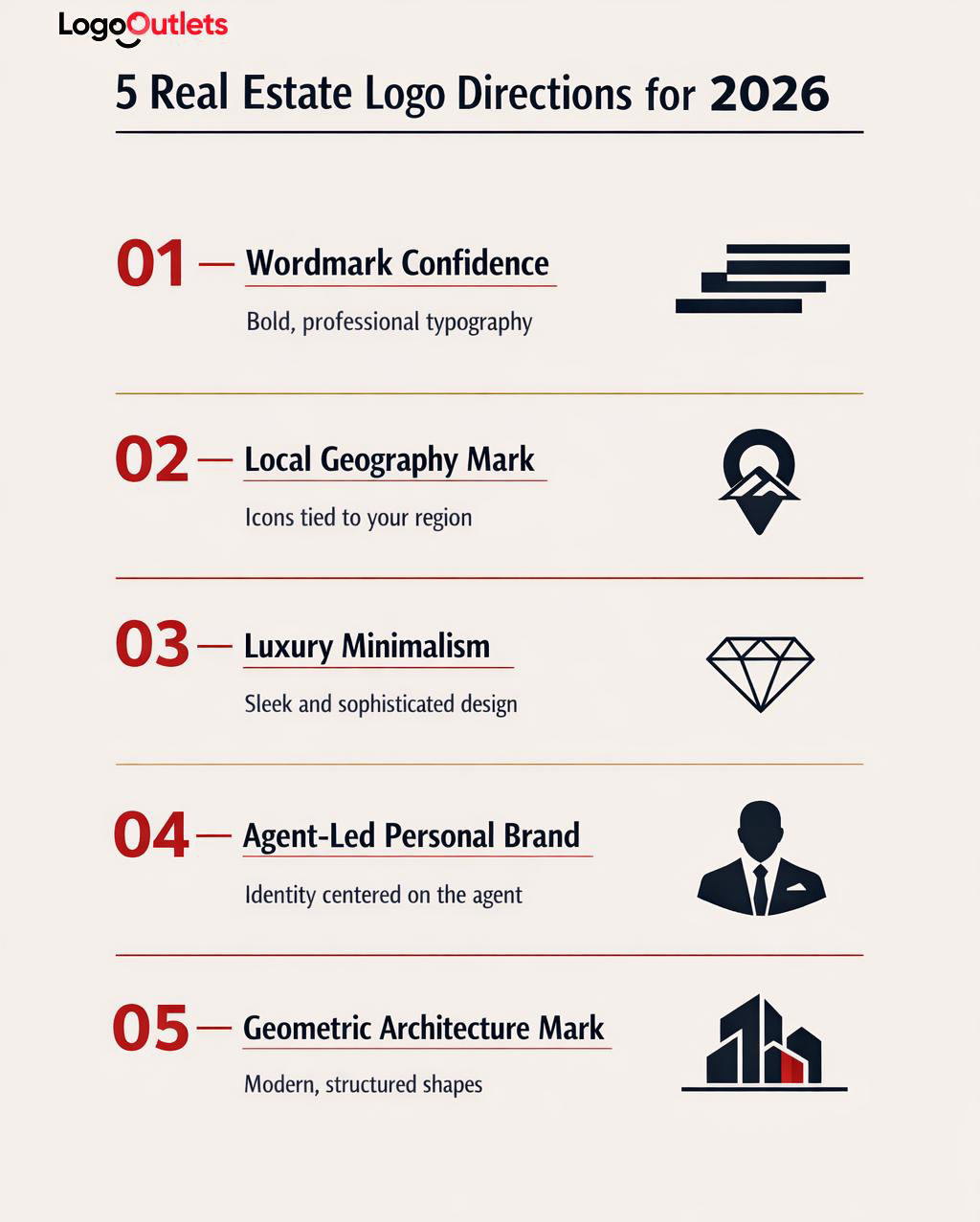
- Wordmark Confidence
The cleanest shift happening in professional real estate branding is the move away from icon-dependent logos toward pure wordmarks.
A well-crafted wordmark — just the agent’s name or brokerage name in a deliberately chosen typeface — communicates something that a house icon never can: that the brand is confident enough not to explain itself visually.
Think of how RE/MAX’s bold red and blue wordmark is instantly recognizable without needing an architectural illustration. The name is the brand.
For individual agents, this direction works particularly well when the agent’s name already has some local recognition, or when they’re actively building a personal brand tied to a specific neighborhood or niche.
- Local Geography Marks
One of the fastest-growing directions in real estate brand identity is incorporating subtle geographic references that are meaningful only to local buyers and sellers.
This might be a skyline silhouette from the city your brokerage serves, a street grid pattern from a high-value neighborhood, or a topographic element from a coastal or mountain market. These logos say nothing to an outsider — and that’s precisely the point. They signal to local clients that you’re from here, not passing through.
- Luxury Minimalism
Luxury real estate logo ideas have converged on a consistent visual language: thin serif or transitional serif typography, generous white space, limited color palettes anchored in black, warm white, or single metallic accent tones. This approach borrows directly from luxury fashion and hospitality, which tells the high-net-worth buyer something immediately: this agent understands the world you inhabit. The restraint is the message.
- Agent-Led Personal Brand Marks
In a saturated brokerage environment, individual agents are increasingly building recognizable personal brands that operate independently of — or in parallel with — their brokerage affiliation. These logos typically combine a clean monogram or signature-style lettermark with a confident supporting typeface.
Keller Williams agents, for example, often carry strong personal brand identities that coexist with the broader KW umbrella. In 2026, this dual-identity approach is becoming more structured and intentional.
- Geometric Architecture Marks
Where house icons feel dated, abstract geometric marks that suggest architectural forms — without literally depicting them — feel contemporary and scalable. A triangular form that implies a roofline without being one. An interlocking geometric pattern that reads as both initials and a floor plan. These marks work because they carry the semantic weight of real estate while escaping the visual clichés.
The Real Problem With Choosing the Wrong Direction
Here’s what most agents and small brokerages get wrong: they choose a logo style based on what they personally like, rather than what their target client needs to feel.
A residential agent working primarily with first-time buyers in an affordable suburb needs a logo that feels warm, approachable, and trustworthy — not cold and minimal.
A luxury condo specialist needs exactly the opposite: restraint, sophistication, and zero visual clutter. A commercial property firm needs structural, geometric authority that reads as serious and institutional.
The logo should be built for the client’s psychology, not the agent’s taste.
Real Estate Logo Ideas: A Comparison Framework
| Logo Direction | Best Suited For | Primary Trust Signal | Common Mistake |
| Wordmark Confidence | Established agents, personal brands | Name recognition, professionalism | Choosing the wrong typeface — too casual or too generic |
| Local Geography Mark | Neighborhood specialists, boutique brokerages | Local authority, community connection | Over-literal depictions that feel like clip art |
| Luxury Minimalism | Luxury residential, high-end commercial | Exclusivity, attention to detail | Going so minimal, the logo has no character |
| Agent Personal Brand Mark | Solo agents building an independent identity | Personality, approachability | Monograms that are illegible at a small scale |
| Geometric Architecture Mark | Mid-market to upscale residential and commercial | Modern, competent, forward-looking | Abstract marks with no connection to real estate |
What Does a Good Real Estate Logo Actually Need to Do?
This is worth answering directly, because the answer is more specific than most people expect.
A strong real estate logo needs to work at three scales simultaneously: large enough for a banner or outdoor signage, medium for printed marketing materials and business cards, and small for a social media profile image or email signature.
Many logos that look beautiful at a large scale completely fall apart at 40×40 pixels. Before any design is finalized, it should be tested at all three sizes.
It also needs to work in black and white. Not because color doesn’t matter — it does — but because a logo that depends on its color to be recognizable is a logo with a structural weakness. The form has to carry the weight first. Color is the amplifier, not the foundation.
Finally, it needs to be yours. This sounds obvious, but the number of real estate logos generated from templates or bought from low-cost marketplaces that end up nearly identical to competitors in the same market is striking. A logo that your nearest competitor could have used isn’t protecting your brand — it’s diluting it.
The Mistakes That Cost Real Estate Professionals the Most
- Using a template logo in a market where your competitor already has. This happens more often than agents realize. When two businesses operating in the same zip code have nearly identical visual identities — because both used the same template service — the confusion damages both brands.
- Treating color as decoration rather than psychology. Color carries real communicative weight. Navy signals stability and trust. Forest green signals growth and community. Warm gold signals premium quality. Black with white space signals luxury and authority. These aren’t arbitrary associations — they’re patterns built through decades of marketing exposure that your clients carry subconsciously. Choosing a color because “it’s your favorite” ignores this entirely.
- Prioritizing complexity over clarity. Elaborate crests, detailed architectural illustrations, and multi-element emblems that look impressive at full size often collapse into visual noise on a phone screen. The most durable logos — across real estate and every other industry — are the ones that can be drawn from memory.
- Skipping the scalability test. A logo that isn’t tested at yard-sign scale, business card scale, and social media avatar scale before finalizing is a logo designed for one context, not a brand asset built for the full range of real estate marketing.
What a Rebranding Moment Actually Looks Like
Consider a familiar scenario in real estate: an agent who spent their first five years under a large franchise brokerage — benefiting from brand recognition but never building their own — decides to go independent or join a boutique firm. Suddenly, for the first time, the visual identity is entirely theirs to define.
This is one of the highest-stakes branding moments in a real estate career. Agents in this position often make one of two mistakes: they either replicate the visual language of their former brokerage (because it’s familiar) or they choose something completely opposite just to feel different, without thinking through what their target client actually needs to see.
The most successful rebrands in this scenario start from a different question entirely: What do my best clients say about working with me, and what do I want my next best clients to feel when they first encounter my name?
That question — not a color preference or a font trend — is the right starting point for any real estate logo identity work.
The American Marketing Association and AIGA both emphasize that effective brand identity is built from strategic positioning outward, not from aesthetic preference inward. The visual follows the strategy. Always.
How Custom Real Estate Logo Design Differs From What a Template Gives You
The honest answer is: significantly, and in ways that compound over time.
A template logo gives you a usable mark quickly. A custom real estate logo gives you a mark that was built around your specific positioning, your specific market, and your specific competitive landscape.
No one else in your market will have it. The files will be properly structured for every application you’ll need. The typography will be chosen for a reason, not for convenience.
This matters in ways that aren’t always obvious upfront. Over time, the agents and brokerages with genuinely distinct visual identities build faster name recognition, command higher perceived authority, and create marketing materials that look consistently professional rather than assembled from disparate parts. Brand recognition is a compound asset — it builds with every impression, but only if those impressions are consistent and distinctive.
Professional real estate logo design is, in this sense, not an expense. It’s the infrastructure that everything else sits on.
Conclusion
The real estate professionals who will dominate local markets visually in 2026 are not the ones who spent the most on design. They’re the ones who asked the right questions first.
Who exactly am I trying to reach?
What do they need to feel when they see my name for the first time?
What does my strongest competitor look like, and how far am I from that?
What does my logo need to do — not just look like?
Real estate logo ideas aren’t really about trends. They’re about clarity, specificity, and the discipline to build a visual identity that works as hard as you do.
A logo rooted in that kind of thinking will still be recognizable, credible, and relevant five years from now — long after the trends it might have chased have faded.
Start with the strategy. The right logo follows naturally.
Frequently Asked Questions
What makes Logo Outlets a good fit for real estate professionals who need a custom logo?
Logo Outlets specializes in custom logo design with a transparent ordering process and 24–48 hour delivery, which works particularly well for agents and brokerages who need professional results quickly without the extended timelines of traditional design agencies. Every logo is built from scratch for your specific positioning, not adapted from a template.
Can Logo Outlets handle real estate branding beyond just the logo — like business cards, signage, or social media templates?
Yes. Logo Outlets offers full brand identity services, including logo design, brand guidelines, and supporting collateral — giving real estate professionals a consistent visual system they can apply across every marketing touchpoint, from yard signs to LinkedIn.
What are the best practices for a real estate logo that has to work across both print and digital?
Design for the most restrictive format first. Test your logo at a small scale (40x40px for social media avatars), in black and white, and at a large print scale before finalizing. If it holds up across all three, it’s built to last.
What logo trends are shaping real estate branding heading into 2026?
The strongest directions include confident wordmarks, locally-specific geography marks, luxury minimalism with restrained typography, and geometric architectural marks that suggest structural form without literal house imagery. Agents are also increasingly building personal brand identities that coexist with their brokerage affiliation.
How do I know when to hire a professional designer rather than use a logo maker?
If you’re building a business you intend to grow — one where your visual identity will appear on yard signs, marketing materials, your website, and social media for years — professional custom design is worth the investment. Logo makers produce usable marks, but they rarely produce differentiated ones.
What does a professional real estate logo cost, and what does that investment actually include?
Professional real estate logo design varies widely, but quality custom work typically includes multiple concept directions, revision rounds, and final files formatted for print, digital, and signage use. The deliverable isn’t just an image — it’s a complete brand asset you own outright.
What’s the best logo style for a luxury real estate brand?
Luxury real estate logos consistently favor restraint: thin serif or transitional serif typography, limited color palettes anchored in black, warm white, or single metallic tones, and generous white space. The visual discipline signals the same attention to detail your high-net-worth clients expect in every other part of their experience.
How does a custom real estate logo help with local market recognition?
A custom logo built around your specific market — incorporating local geographic references, typography that fits your target client’s expectations, and a color palette chosen for its psychological associations — creates a compound visual advantage. Every impression builds faster recognition because there’s nothing else in your market that looks quite like it.